

Starving the Dream: Dr. Nathan Alleman’s Mission to Confront Campus Hunger
by Gabriela Garcia
The idea of hunger on a college campus — especially at a private, highly resourced university like Baylor — seems unimaginable. Yet nearly a decade of research led by Dr. Nathan Alleman, associate professor of Educational Leadership and Graduate Program Director for the Higher Education and Student Affairs (HESA) MSEd program, and his then‑students — Dr. Cara Cliburn Allen and Dr. Sarah E. Madsen — revealed a more complicated and sobering truth. Their work, conducted across three prestigious, selective universities, demonstrated that food insecurity is not a problem confined to community colleges or underfunded institutions. It is woven into the lived experiences of students nationwide, including those attending prestige-oriented campuses.
Food insecurity among college students is often discussed in terms of missed meals or limited access to groceries. However, reality is far more complex. As Alleman explains, “The challenges of struggling with the cost of food go way beyond paying for food—they include affording club dues, weekend trips with friends, and even just stopping by Starbucks on the way to class, all ‘normal’ activities that create immense stress for students with tight budgets.” This broader perspective highlights how financial strain affects not only students’ physical well-being but also their social and academic experiences.
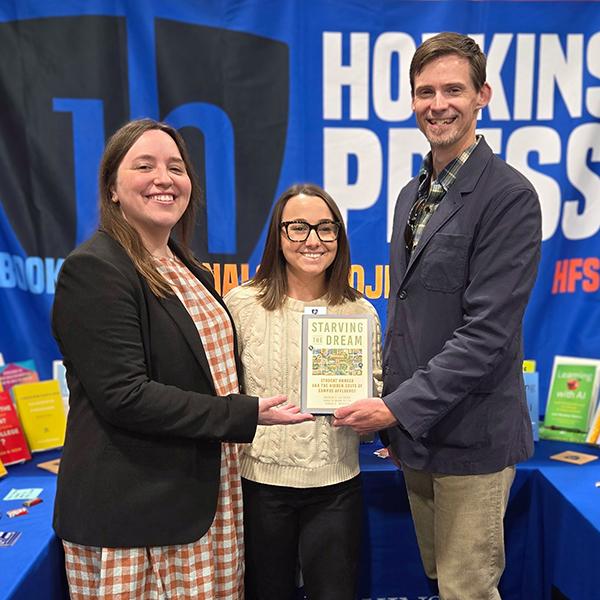
What began as Alleman’s curiosity about hunger at Baylor evolved into nationally recognized scholarship, a campus movement, and now a landmark book: Starving the Dream: Student Hunger and the Costs of Campus Affluence (Johns Hopkins University Press, 2025), co‑authored by Alleman, Cliburn Allen, and Madsen. The book is an appeal to university leaders and others concerned about equity beyond mere access; it provides a blueprint for meaningful change that builds on understanding the full experiences of those experiencing food insecurity and recognizing the systemic challenges of the university setting.
How the Research Began
The story starts in 2017, when Alleman and doctoral student Cara Cliburn Allen heard about food insecurity in community colleges and regional 4-year universities. This led them to wonder if the issue is also true at a place like Baylor University. Motivated to understand Baylor’s own context, Alleman and Cliburn Allen surveyed 1,500 students most likely to experience food insecurity. This population included first-generation college students, veterans, international students, and transfer students. Of the 300 who responded, half reported some level of food insecurity. Their findings made it clear that students at prestigious universities were not exempt from food insecurity. During interviews that followed, students described skipping meals, relying on free campus events for food, and lacking transportation to affordable grocery stores. The data made one thing clear: hunger was present, and it was affecting students’ well-being, academic performance, and sense of belonging, especially for those students already on the social and economic margins.
From Research to Action: The Birth of Baylor’s Farmers Market
The research did not remain theoretical. Alleman and Cliburn Allen convened a working group of faculty, staff, administrators, and community partners to respond directly to the problem. Their leadership — and their insistence that Baylor act rather than observe — jumpstarted a movement.
Their efforts culminated in Baylor’s first Free Farmers Market, held in November 2016 on Fountain Mall in partnership with Family of Faith Worship Center and Pastor Reuben Andrade. More than 40,000 pounds of food were distributed to 1,500 students, despite pouring rain. This event, initiated and driven by Alleman and Cliburn Allen, and joined by many other campus partners, became the catalyst for everything that followed.
Building Sustainable Support
When Madsen joined the research team, she became the inaugural apprentice of the campus food pantry, helping expand access to fresh produce and pantry staples. Her work helped normalize conversations about food insecurity and encouraged students to seek support without shame.
The following year, Alleman integrated students who had volunteered to share their experiences with a qualitative research methods class. Together, Alleman and Cliburn Allen produced the first academic journal publication on food insecurity at selective universities, A Private Struggle at a Private Institution (Journal of College Student Development, 2019). This activism and scholarship secured an internal grant for a larger study that served as the foundation for the Starving the Dream book.
A National Contribution
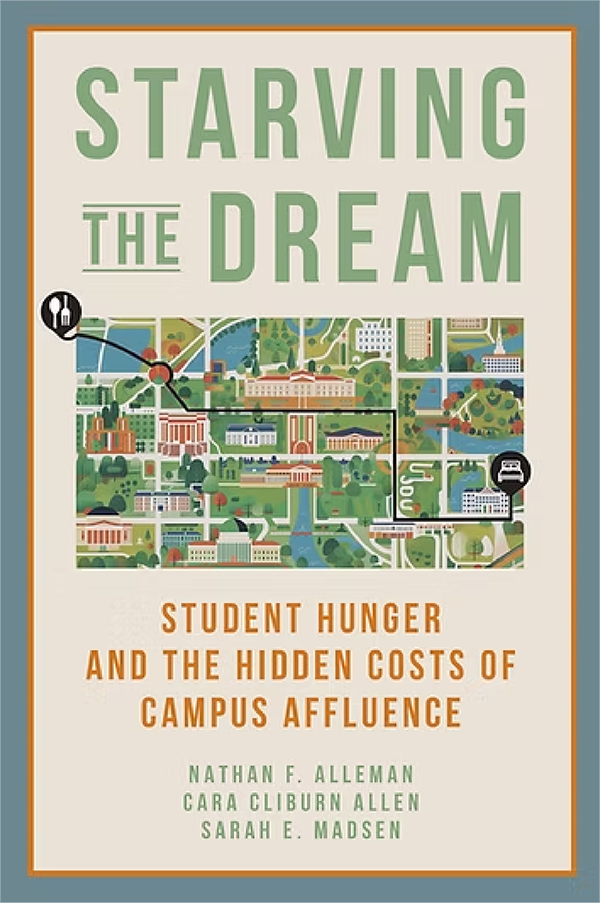
Starving the Dream represents a major milestone in Alleman’s long‑term commitment to understanding collegiate food insecurity. Drawing on extensive qualitative research at three prestige-oriented universities, the book examines how students navigate hunger in environments where affluence is assumed.
The authors highlight the tension between campus culture and student reality. Students feel pressure to participate in organizations, social events, and academic opportunities that require financial resources. Many hide their food insecurity to avoid stigma or the perception that they do not belong. Administrators struggle to reconcile the image of an affluent campus with the needs of students who are quietly going without.
The book argues that food insecurity is not simply about access to food — it is about belonging, identity, and the hidden costs of higher education.
Extending the Research
With support from a Spencer Foundation racial equity grant, Alleman and his collaborators are now conducting the first known longitudinal studies on collegiate food insecurity. They are reconnecting with participants five and ten years after their initial interviews to explore how early experiences of hunger shaped career paths, financial decision‑making, family formation, and self‑concept.
This work is among the first to examine the long‑term developmental impact of food insecurity, offering insights that could influence policy and practice nationwide.
The Legacy of Alleman, Cliburn Allen, and Madsen
Through research, teaching, and collaborative action, Alleman continues to illuminate the experiences of students who are too often overlooked. Madsen carried this work through her doctoral and postdoctoral journey, completing a dissertation on consumers and consumerism in higher education. Cliburn Allen now serves as the Director of Pre-Award Administration for Office of the Vice Provost for Research at Baylor.
Their message is clear: context matters, and solutions must be shaped by the lived realities of students themselves. Baylor’s campus — thanks to the leadership of Alleman, Cliburn Allen, and Madsen — has become a model for other universities seeking compassionate, research‑informed innovation.